Salvini and the pro-Russia camp: why so many in Italy are rooting for Putin
The League leader has been re-elected after pledging to block further weapons and aid for Kyiv. But from Roberto Vannacci to the Five Star Movement and the far left, sympathy for Moscow stretches across much of Italy’s political spectrum
Intelligence Engine
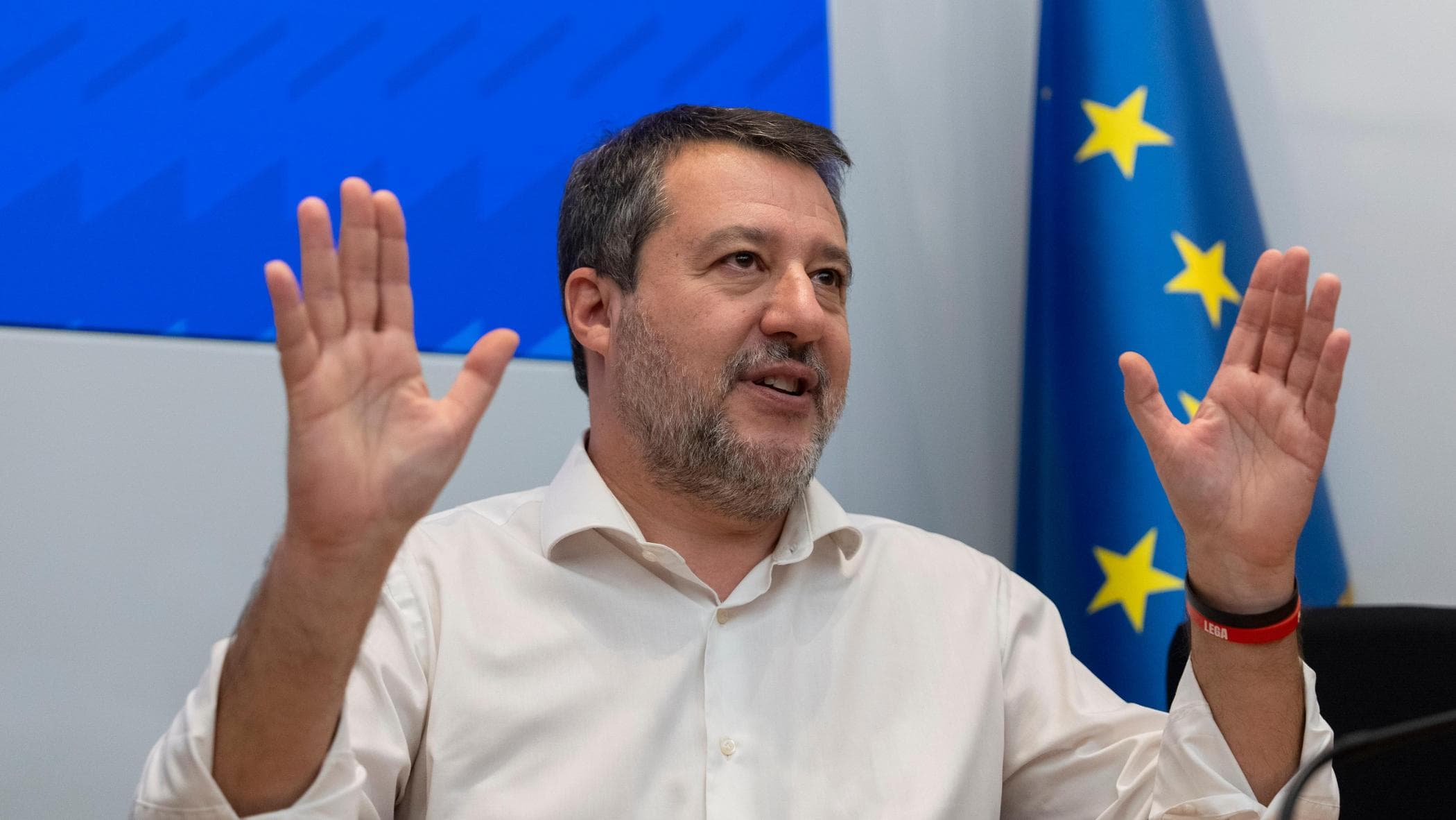
Shortly before being re-elected leader of the League on 25 October, Matteo Salvini made it abundantly clear how, in his view, the offensive campaign launched by Russia’s Z-marked army in February 2022 could be helped along.
“If you re-elect me as secretary, this congress will give me a mandate to go to the cabinet and make the League’s position absolutely clear: we cannot go on sending money and weapons to Ukraine.” The Italian deputy prime minister’s pro-Russian stance should come as no surprise, given that a decade ago he declared himself willing to trade “two Mattarellas for half a Putin” and has never concealed his admiration for the autocrat in Moscow.
But Salvini is far from alone. And if Putin, Trump and Xi Jinping strike a deal in November behind the backs of the European Union and Kyiv, plenty of people in Italy will be cheering them on.
Russophilia cuts across the entire political spectrum, from the far left to the far right. It is a longstanding and deeply entrenched feature of certain strands of Italian political culture, so much so that a term has even been coined to describe this strange mix of opponents of liberal democracy: the rossobruni, or “red-browns”.
Leaving aside for a moment suspicions about politicians taking their orders and funding from the Kremlin — something Europe has certainly seen before — sympathy for Moscow has deep roots in Italy, fed by three major currents of political and cultural thought.
There are, of course, those who remain nostalgic for the Italian Communist Party, the largest in the Western world, which maintained close ties with Moscow at least until 1976, when its leader Enrico Berlinguer declared that he felt safer “under NATO’s umbrella” than under the Warsaw Pact.
Then there are the former voters of the neo-fascist Italian Social Movement (MSI), which emerged from the ashes of Benito Mussolini’s Republic of Salò. They harboured a deep hatred of liberal democracies, particularly the United States, which they blamed for the defeat of the Fascist regime.
But significant sections of Italy’s Catholic political culture, too, have long been drawn to Third World movements, viewing the kingdom of consumerism with suspicion, opposing American imperialism and advocating peace in the face of nuclear missile deployments in Europe.
It was this sentiment that recently led Pope Francis himself — far removed from the fierce anti-communism of the Polish Karol Wojtyła — to accuse NATO of “barking at Russia’s door”, effectively endorsing the argument that the war had been provoked by the West’s aggressive behaviour.
Putin’s friends in Italy can therefore count on the most important asset of all, and the hardest to acquire: a natural affinity for Russia among a substantial section of the population.
Russia’s ambassador to Italy, Alexey Paramonov, acknowledged this undeniable reality with a degree of satisfaction in an interview with the TASS news agency: “The issue of Russia and relations with Russia is emerging as one of the main dividing lines in the country’s domestic political debate.”
Salvini’s League is currently the leading advocate of a policy of appeasement towards Moscow, with all that entails, including the economic consequences and the lifting of sanctions.
On 16 July 2026, addressing a gathering of Italian businesspeople still operating in Russia, the deputy prime minister questioned the effectiveness of sanctions — including the few that are working — and argued that giving up Russian gas was damaging Italy’s economy without bringing an end to the conflict any closer.
Although the League is polling at just 6%, it still wields considerable political influence within the Italian government, with significant consequences.
It is no coincidence that Italy has yet to approve a new package of military aid for Ukraine, despite nearly a year of delays and Giorgia Meloni’s promises to President Volodymyr Zelensky.
But while Salvini is the most conspicuous pro-Russian figure within the governing coalition — not least because he can push Italian foreign policy in an anti-Ukrainian direction — some of the Kremlin’s staunchest allies are to be found in the opposition.
Once again, the search leads to the right, this time to the newly formed Futuro Nazionale (National Future) party, led by Roberto Vannacci, a former special forces general who now sits in opposition to Meloni’s government.
Peace with Moscow and leaving Ukraine to its fate have become the recurring themes of the Futuristi, as Vannacci’s supporters like to call themselves — a name that evokes the early 20th-century artistic avant-garde movement that eventually embraced Fascism.
Vannacci, who was elected to the European Parliament while still a member of the League, attacks Ukrainian resistance at every opportunity, echoing Kremlin propaganda on an almost daily basis.
On 21 October, speaking during a plenary session in Strasbourg, he added another brick to the sovereigntist wall of opposition to Kyiv:
“Either you give me €70 billion, or I’ll have you invaded by 20 million Ukrainians. This is Volodymyr Zelensky’s new frontier: from ‘we are fighting to defend your families’ to blackmail using his own citizens.”
Admiration for Putin and a willingness to believe virtually anything coming out of the Kremlin are nothing new for the former commander of Italy’s paratroopers and former Italian military attaché in Moscow.
An illuminating account of a face-to-face encounter with Vannacci was given to Repubblica by John Foreman, his British counterpart, who had served as military attaché in Moscow and, before that, in Kyiv. Foreman recalled the days leading up to Russia’s invasion of Ukraine in February 2022:
“It was late January 2022. We were having a drink before dinner, discussing the build-up of Russian troops on the border, and he said to me, ‘Come on, John, Moscow isn’t going to invade Ukraine.’
“But he really didn’t want to listen. At least the French later came up to me and said, ‘You were right.’ Vannacci never did. He was almost living in a parallel universe. In my view, that was down to a poor understanding of the situation and his admiration for a ‘strong Russia’.”
The lack of sympathy for Ukraine’s cause is not confined to the far right represented by Vannacci and Salvini.
Within the left-wing opposition, which hopes to present itself as an alternative to Meloni, there are also factions pushing in the same direction.
Nor is this simply a matter of the pacifism embraced by large sections of the electorate and leadership of the Green and Left Alliance.
The Five Star Movement (M5S), which emerged as an anti-establishment force, had already adopted a critical stance towards NATO and the West even before Giuseppe Conte became its leader.
Its founder, Beppe Grillo, the comedian behind the M5S’s spectacular electoral breakthrough in 2013, when it won more than 25% of the vote — a success repeated in 2018 with 32% — has never made a secret of his views on Putin.
As early as 2017, during Trump’s first presidency, he praised the dialogue between the two strongmen in these terms:
“If Trump wants to find common ground with Putin and put things back on the right track, he can only have our support. Two giants like them talking to each other: it’s the whole world’s dream! International politics needs strong statesmen like them. I see this as a benefit for humanity. Putin is the one who says the most sensible things about foreign policy.”
Even today, support for Ukraine remains the main stumbling block in relations between the Democratic Party (PD), led by Elly Schlein, and Giuseppe Conte’s Five Star Movement.
Conte has promised a radical change in foreign policy if the centre-left wins the election, starting with a halt to arms supplies.
“It seems to me that Ukraine is, at this point, an extremely well-armed country. We want to help Ukrainians in a different way, by steering the conflict towards a peaceful resolution.”
In the Italian parliament, Five Star lawmakers have also voted in favour of motions calling for the resumption of Russian gas purchases — one of the main sources of revenue Putin uses to finance his war of aggression against Ukraine.
So while Giorgia Meloni has changed her position on Putin, seeking to erase memories of the years she spent vocally opposing sanctions against Russia, for former prime minister Giuseppe Conte it is a return to his old policy of equidistance and neutrality towards Moscow.
It was this approach that led him, during his time as prime minister, to accept Putin’s offer of assistance during the Covid emergency.
On 22 March 2020, 13 four-engine Ilyushin aircraft landed at the Pratica di Mare military airbase near Rome, carrying 104 people.
The Russian mission, which under the initial agreements could have been granted access to all Italian public facilities, included 28 doctors and four nurses.
Everyone else was military personnel.
Read Full Intelligence Briefing
Access the complete report and original data sources from La Repubblica.
View Source MaterialRelated Intelligence

After mega listing, Anthropic emerges among the most traded stocks by Indian retail investors
11/21/2026
Supermarket sweep: Morrisons, Tesco and M&S back Government's business-boosting food trade deal with Europe
11/21/2026
'Costs cut': Prime Minister secures deal with EU to cut costs, keep prices down and create opportunities for young people worth up to £17 billion per year
11/21/2026