Hadean mantle depletion and 3.95-Gyr subduction implied by North China rocks
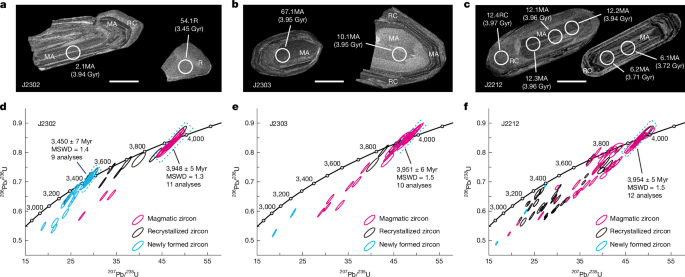
Analysis of a 3.95-Gyr-old trondhjemitic gneiss from eastern Hebei, China, reveals a composition suggesting a low-temperature altered basaltic source, that originated from a mantle depleted in the Hadean, was most likely transported to mantle depths…
Intelligence Engine
ReferencesBowring, S. A. & Williams, I. S. Priscoan (4.00–4.03Ga) orthogneisses from northwestern Canada. Contrib. Mineral. Petrol. 134, 3–16 (1999). Article
Reimink, J. R., Chacko, T., Stern, R. A. & Heaman, L. M. The birth of a cratonic nucleus: lithogeochemical evolution of the 4.02–2.94 Ga Acasta Gneiss Complex. Precambrian Res. 281, 453–472 (2016). Article
Reimink, J. R., Chacko, T., Stern, R. A. & Heaman, L. M. Earth’s earliest evolved crust generated in an Iceland-like setting. Nat. Geosci. 7, 529–533 (2014). Article
Moyen, J.-F. The composite Archaean grey gneisses: petrological significance, and evidence for a non-unique tectonic setting for Archaean crustal growth. Lithos 123, 21–36 (2011). Article
O’Neil, J., Carlson, R. W., Francis, D. & Stevenson, R. K. Neodymium-142 evidence for Hadean mafic crust. Science 321, 1828–1831 (2008). Article
Sole, C. et al. Evidence for Hadean mafic intrusions in the Nuvvuagittuq Greenstone Belt, Canada. Science 388, 1431–1435 (2025). Article
Augland, L. E. & David, J. Protocrustal evolution of the Nuvvuagittuq Supracrustal Belt as determined by high precision zircon Lu–Hf and U–Pb isotope data. Earth Planet. Sci. Lett. 428, 162–171 (2015). Article
Shimojo, M. et al. Occurrence and geochronology of the Eoarchean, ~3.9 Ga, Iqaluk Gneiss in the Saglek Block, northern Labrador, Canada: evidence for the oldest supracrustal rocks in the world. Precambrian Res. 278, 218–243 (2016). Article
Cates, N. L. & Mojzsis, S. J. Pre-3750 Ma supracrustal rocks from the Nuvvuagittuq supracrustal belt, northern Québec. Earth Planet. Sci. Lett. 255, 9–21 (2007). Article
Nutman, A. P. et al. Fifty years of the Eoarchean and the case for evolving uniformitarianism. Precambrian Res. 367, 106442 (2021). Article
Harley, S. L. & Kelly, N. M. in Developments in Precambrian Geology Vol. 15 (eds van Kranendonk, M. J. et al.) 149–186 (Elsevier, 2007). Liu, D. Y., Nutman, A. P., Compston, W., Wu, J. S. & Shen, Q. H. Remnants of ≥3800 Ma crust in the Chinese part of the Sino-Korean craton. Geology 20, 339–342 (1992). Article
Ge, R., Zhu, W., Wilde, S. A. & Wu, H. Remnants of Eoarchean continental crust derived from a subducted proto-arc. Sci. Adv. 4, eaao3159 (2018). Article
Johnson, T. E. et al. An impact melt origin for Earth’s oldest known evolved rocks. Nat. Geosci. 11, 795–799 (2018). Article
Guitreau, M., Blichert-Toft, J., Martin, H., Mojzsis, S. J. & Albarède, F. Hafnium isotope evidence from Archean granitic rocks for deep-mantle origin of continental crust. Earth Planet. Sci. Lett. 337–338, 211–223 (2012). Article
Dong, C. et al. New discovery of 3.84–3.64 Ga diverse granitoids in eastern Hebei, North China Craton: petrogenesis and significance. GSA Bull. 136, 5249–5261 (2024). Article
OʼNeil, J., Boyet, M., Carlson, R. W. & Paquette, J.-L. Half a billion years of reworking of Hadean mafic crust to produce the Nuvvuagittuq Eoarchean felsic crust. Earth Planet. Sci. Lett. 379, 13–25 (2013). Article
Wang, D., Qiu, X.-F. & Carlson, R. W. The Eoarchean Muzidian gneiss complex: long-lived Hadean crustal components in the building of Archean continents. Earth Planet. Sci. Lett. 605, 118037 (2023). Article
Bennett, V. C., Brandon, A. D. & Nutman, A. P. Coupled 142Nd-143Nd isotopic evidence for Hadean mantle dynamics. Science 318, 1907–1910 (2007). Article
Rizo, H., Boyet, M., Blichert-Toft, J. & Rosing, M. T. Early mantle dynamics inferred from 142Nd variations in Archean rocks from southwest Greenland. Earth Planet. Sci. Lett. 377–378, 324–335 (2013). Article
Li, C.-F. et al. Differentiation of the early silicate Earth as recorded by 142Nd-143Nd in 3.8–3.0 Ga rocks from the Anshan Complex, North China Craton. Precambrian Res. 301, 86–101 (2017). Article
Liou, P. et al. Long-term isolation of Hadean mantle domains revealed from coupled 147-146Sm-143-142Nd systematics in the eastern North China Craton. Earth Planet. Sci. Lett. 638, 118761 (2024). Article
Vervoort, J. D. & Kemp, A. I. S. Isotope evolution of the depleted mantle. Annu. Rev. Earth Planet. Sci. 53, 195–221 (2025). Article
Valley, J. W. et al. 4.4 billion years of crustal maturation: oxygen isotope ratios of magmatic zircon. Contrib. Mineral. Petrol. 150, 561–580 (2005). Article
Chen, R.-X., Zheng, Y.-F. & Xie, L. Metamorphic growth and recrystallization of zircon: distinction by simultaneous in-situ analyses of trace elements, U–Th–Pb and Lu–Hf isotopes in zircons from eclogite-facies rocks in the Sulu orogen. Lithos 114, 132–154 (2010). Article
Ge, R.-F., Wilde, S. A., Zhu, W.-B. & Wang, X.-L. Earth’s early continental crust formed from wet and oxidizing arc magmas. Nature 623, 334–339 (2023). Article
Koshida, K., Ishikawa, A., Iwamori, H. & Komiya, T. Petrology and geochemistry of mafic rocks in the Acasta Gneiss Complex: implications for the oldest mafic rocks and their origin. Precambrian Res. 283, 190–207 (2016). Article
Rollinson, H. Do all Archaean TTG rock compositions represent former melts? Precambrian Res. 367, 106448 (2021). Article
Liou, P. & Guo, J. Generation of Archaean TTG gneisses through amphibole-dominated fractionation. J. Geophys. Res. Solid Earth 124, 3605–3619 (2019). Article
Laurent, O. et al. Earth’s earliest granitoids are crystal-rich magma reservoirs tapped by silicic eruptions. Nat. Geosci. 13, 163–169 (2020). Tiepolo, M., Oberti, R., Zanetti, A., Vannucci, R. & Foley, S. F. Trace-element partitioning between amphibole and silicate melt. Rev. Mineral. Geochem. 67, 417–452 (2007). Article
Kemp, A. I. S. et al. Hadean crustal evolution revisited: new constraints from Pb–Hf isotope systematics of the Jack Hills zircons. Earth Planet. Sci. Lett. 296, 45–56 (2010). Article
Amelin, Y., Kamo, S. L. & Lee, D.-C. Evolution of early crust in chondritic or non-chondritic Earth inferred from U–Pb and Lu–Hf data for chemically abraded zircon from the Itsaq Gneiss Complex, West Greenland. Can. J. Earth Sci. 48, 141–160 (2011). Article
Hiess, J., Bennett, V. C., Nutman, A. P. & Williams, I. S. In situ U–Pb, O and Hf isotopic compositions of zircon and olivine from Eoarchaean rocks, West Greenland: new insights to making old crust. Geochim. Cosmochim. Acta 73, 4489–4516 (2009). Article
Wu, F.-Y., Zhang, Y.-B., Yang, J.-H., Xie, L.-W. & Yang, Y.-H. Zircon U–Pb and Hf isotopic constraints on the Early Archean crustal evolution in Anshan of the North China Craton. Precambrian Res. 167, 339–362 (2008). Article
Vezinet, A. et al. Growth of continental crust and lithosphere subduction in the Hadean revealed by geochemistry and geodynamics. Nat. Commun. 16, 3850 (2025). Article
Rosas, J. C. & Korenaga, J. Rapid crustal growth and efficient crustal recycling in the early Earth: implications for Hadean and Archean geodynamics. Earth Planet. Sci. Lett. 494, 42–49 (2018). Article
Herzberg, C., Condie, K. & Korenaga, J. Thermal history of the Earth and its petrological expression. Earth Planet. Sci. Lett. 292, 79–88 (2010). Article
Johnson, T. E., Brown, M., Gardiner, N. J., Kirkland, C. L. & Smithies, R. H. Earth’s first stable continents did not form by subduction. Nature 543, 239–242 (2017). Article
Smithies, R. H. et al. Oxygen isotopes trace the origins of Earth’s earliest continental crust. Nature 592, 70–75 (2021). Article
Gerya, T. V., Stern, R. J., Baes, M., Sobolev, S. V. & Whattam, S. A. Plate tectonics on the Earth triggered by plume-induced subduction initiation. Nature 527, 221–225 (2015). Article
Baes, M., Sobolev, S., Gerya, T., Stern, R. & Brune, S. Plate motion and plume-induced subduction initiation. Gondwana Res. 98, 277–288 (2021). Article
O’Neill, C., Marchi, S., Zhang, S. & Bottke, W. Impact-driven subduction on the Hadean Earth. Nat. Geosci. 10, 793–797 (2017). Article
Kitoga, L. S. et al. Silicified seafloor contribution to TTG formation: insights from zircon O and Si isotopes. Geochem. Perspect. Lett. 39, 22–27 (2026). Article
Griffin, W. L. et al. The Hf isotope composition of cratonic mantle: LAM-MC-ICPMS analysis of zircon megacrysts in kimberlites. Geochim. Cosmochim. Acta 64, 133–147 (2000). Article
Griffin, W. L. et al. Zircon chemistry and magma mixing, SE China: in-situ analysis of Hf isotopes, Tonglu and Pingtan igneous complexes. Lithos 61, 237–269 (2002). Article
Amelin, Y., Lee, D.-C., Halliday, A. N. & Pidgeon, R. T. Nature of the Earth’s earliest crust from hafnium isotopes in single detrital zircons. Nature 399, 252–255 (1999). Article
Black, L. P. et al. Improved 206Pb/238U microprobe geochronology by the monitoring of a trace-element-related matrix effect; SHRIMP, ID–TIMS, ELA–ICP–MS and oxygen isotope documentation for a series of zircon standards. Chem. Geol. 205, 115–140 (2004). Article
Wiedenbeck, M. et al. Further characterisation of the 91500 zircon crystal. Geostand. Geoanalytical Res. 28, 9–39 (2004). Article
Williams, I. S. in Applications of Microanalytical Techniques to Understanding Mineralizing Processes Vol. 7 (eds McKibben, M. A. et al.) 1–35 (Society of Economic Geologists, Inc., 1998). Nasdala, L. et al. Zircon M257 - a homogeneous natural reference material for the ion microprobe U-Pb analysis of zircon. Geostand. Geoanalytical Res. 32, 247–265 (2008). Article
Stacey, J. S. & Kramers, J. D. Approximation of terrestrial lead isotope evolution by a two-stage model. Earth Planet. Sci. Lett. 26, 207–221 (1975). Article
Ludwig, K. R. SQUID 1.02, A User’s Manual. Berkeley Geochronology Center Special Publication No. 2, 17 pp (2001). Ludwig, K. R. User’s Manual for Isoplot 3.00: A Geochronological Toolkit for Microsoft Excel. Berkeley Geochronology Center Special Publication No. 4, 71 pp (2003). Ickert, R. B. et al. Determining high precision, in situ, oxygen isotope ratios with a SHRIMP II: analyses of MPI-DING silicate-glass reference materials and zircon from contrasting granites. Chem. Geol. 257, 114–128 (2008). Article
Wan, Y. et al. Extreme zircon O isotopic compositions from 3.8 to 2.5 Ga magmatic rocks from the Anshan area, North China Craton. Chem. Geol. 352, 108–124 (2013). Article
Coble, M. A. et al. Trace element characterisation of MAD-559 zircon reference material for ion microprobe analysis. Geostand. Geoanalytical Res. 42, 481–497 (2018). Article
Yuan, H.-L. et al. Simultaneous determinations of U–Pb age, Hf isotopes and trace element compositions of zircon by excimer laser-ablation quadrupole and multiple-collector ICP-MS. Chem. Geol. 247, 100–118 (2008). Article
Bao, Z. et al. Comparison of synthetic zircon, high-temperature and high-pressure sintered zircon and fast hot-pressing sintered zircon for in situ hafnium isotope analysis by LA-MC-ICP-MS. J. Anal. At. Spectrom. 38, 2313–2323 (2023). Article
Patchett, P. J. & Tatsumoto, M. A routine high-precision method for Lu-Hf isotope geochemistry and chronology. Contrib. Mineral. Petrol. 75, 263–267 (1981). Article
Thirlwall, M. F. & Anczkiewicz, R. Multidynamic isotope ratio analysis using MC–ICP–MS and the causes of secular drift in Hf, Nd and Pb isotope ratios. Int. J. Mass Spectrom. 235, 59–81 (2004). Article
Vervoort, J. D., Patchett, P. J., Söderlund, U. & Baker, M. Isotopic composition of Yb and the determination of Lu concentrations and Lu/Hf ratios by isotope dilution using MC-ICPMS. Geochem. Geophys. Geosyst. 5, Q11002 (2004). Article
Sláma, J. et al. Plešovice zircon — a new natural reference material for U–Pb and Hf isotopic microanalysis. Chem. Geol. 249, 1–35 (2008). Article
Fisher, C. M., Vervoort, J. D. & DuFrane, S. A. Accurate Hf isotope determinations of complex zircons using the “laser ablation split stream” method. Geochem. Geophys. Geosyst. 15, 121–139 (2014). Article
Söderlund, U., Patchett, P. J., Vervoort, J. D. & Isachsen, C. E. The 176Lu decay constant determined by Lu–Hf and U–Pb isotope systematics of Precambrian mafic intrusions. Earth Planet. Sci. Lett. 219, 311–324 (2004). Article
Bouvier, A., Vervoort, J. D. & Patchett, P. J. The Lu–Hf and Sm–Nd isotopic composition of CHUR: constraints from unequilibrated chondrites and implications for the bulk composition of terrestrial planets. Earth Planet. Sci. Lett. 273, 48–57 (2008). Article
Ickert, R. B. Algorithms for estimating uncertainties in initial radiogenic isotope ratios and model ages. Chem. Geol. 340, 131–138 (2013). Article
Furnes, H., Rosing, M., Dilek, Y. & de Wit, M. Isua supracrustal belt (Greenland)—a vestige of a 3.8 Ga suprasubduction zone ophiolite, and the implications for Archean geology. Lithos 113, 115–132 (2009). Article
Hoffmann, J. E. et al. Mechanisms of Archean crust formation inferred from high-precision HFSE systematics in TTGs. Geochim. Cosmochim. Acta 75, 4157–4178 (2011). Article
O’Neil, J., Francis, D. & Carlson, R. W. Implications of the Nuvvuagittuq greenstone belt for the formation of Earth’s early crust. J. Petrol. 52, 985–1009 (2011). Article
O’Neil, J., Carlson, R. W., Papineau, D., Levine, E. Y. & Francis, D. in Earth’s Oldest Rocks 2nd edn (eds van Kranendonk, M. J. et al.) 349–374 (Elsevier, 2019). Caro, G., Morino, P., Mojzsis, S. J., Cates, N. L. & Bleeker, W. Sluggish Hadean geodynamics: evidence from coupled 146,147Sm–142,143Nd systematics in Eoarchean supracrustal rocks of the Inukjuak domain (Québec). Earth Planet. Sci. Lett. 457, 23–37 (2017). Article
Wasilewski, B., O’Neil, J. & Rizo, H. Geochemistry and petrogenesis of the early Archean mafic crust from the Saglek-Hebron Complex (Northern Labrador). Precambrian Res. 328, 321–343 (2019). Article
Vigneresse, J. L., Barbey, P. & Cuney, M. Rheological transitions during partial melting and crystallization with application to felsic magma segregation and transfer. J. Petrol. 37, 1579–1600 (1996). Article
Brown, M. Crustal melting and melt extraction, ascent and emplacement in orogens: mechanisms and consequences. J. Geol. Soc. 164, 709–730 (2007). Article
Rosenberg, C. L. & Handy, M. R. Experimental deformation of partially melted granite revisited: implications for the continental crust. J. Metamorph. Geol. 23, 19–28 (2005). Article
Xiang, H. & Connolly, J. A. D. GeoPS: an interactive visual computing tool for thermodynamic modelling of phase equilibria. J. Metamorph. Geol. 40, 243–255 (2022). Article
Holland, T. J. B. & Powell, R. An improved and extended internally consistent thermodynamic dataset for phases of petrological interest, involving a new equation of state for solids. J. Metamorph. Geol. 29, 333–383 (2011). Article
Green, E. C. R. et al. Activity–composition relations for the calculation of partial melting equilibria in metabasic rocks. J. Metamorph. Geol. 34, 845–869 (2016). Article
White, R. W., Powell, R. & Johnson, T. E. The effect of Mn on mineral stability in metapelites revisited: new a–x relations for manganese-bearing minerals. J. Metamorph. Geol. 32, 809–828 (2014). Article
Holland, T. & Powell, R. Activity–composition relations for phases in petrological calculations: an asymmetric multicomponent formulation. Contrib. Mineral. Petrol. 145, 492–501 (2003). Article
White, R. W., Powell, R. & Clarke, G. L. The interpretation of reaction textures in Fe-rich metapelitic granulites of the Musgrave Block, central Australia: constraints from mineral equilibria calculations in the system K2O–FeO–MgO–Al2O3–SiO2–H2O–TiO2–Fe2O3. J. Metamorph. Geol. 20, 41–55 (2002). Article
Loucks, R. R., Fiorentini, M. L. & Henríquez, G. J. New Magmatic oxybarometer using trace elements in zircon. J. Petrol. 61, egaa34 (2020). Article
Sobolev, A. V. et al. Deep hydrous mantle reservoir provides evidence for crustal recycling before 3.3 billion years ago. Nature 571, 555–559 (2019). Article
Bédard, J. H. A catalytic delamination-driven model for coupled genesis of Archaean crust and sub-continental lithospheric mantle. Geochim. Cosmochim. Acta 70, 1188–1214 (2006). Article
Qian, Q. & Hermann, J. Partial melting of lower crust at 10–15 kbar: constraints on adakite and TTG formation. Contrib. Mineral. Petrol. 165, 1195–1224 (2013). Article
Xiong, X. et al. Partitioning of Nb and Ta between rutile and felsic melt and the fractionation of Nb/Ta during partial melting of hydrous metabasalt. Geochim. Cosmochim. Acta 75, 1673–1692 (2011). Article
Hulsbosch, N., Hertogen, J., Dewaele, S., André, L. & Muchez, P. Alkali metal and rare earth element evolution of rock-forming minerals from the Gatumba area pegmatites (Rwanda): quantitative assessment of crystal-melt fractionation in the regional zonation of pegmatite groups. Geochim. Cosmochim. Acta 132, 349–374 (2014). Article
Icenhower, J. & London, D. An experimental study of element partitioning among biotite, muscovite, and coexisting peraluminous silicic melt at 200 MPa (H2O). Am. Mineral. 80, 1229–1251 (1995). Article
Raimbault, L. & Burnol, L. The Richemont rhyolite dyke, Massif Central, France; a subvolcanic equivalent of rare-metal granites. Can. Mineral. 36, 265–282 (1998). CAS
Xie, H. et al. Data for “Hadean mantle depletion and 3.95-Gyr subduction implied by North China rocks”. Zenodo https://doi.org/10.5281/zenodo.22911249 (2026). Wan, Y. S. et al. Early Neoarchean (~2.7 Ga) tectono-thermal events in the North China Craton: a synthesis. Precambrian Res. 247, 45–63 (2014). Article
Chu, H. et al. The geological significance of the rediscovered fuchsite quartzite with abundant Eoarchean detrital zircons in eastern Hebei Province [in Chinese with English abstract]. Chin. Sci. Bull. 61, 2299–2308 (2016).
Wan, Y. S. et al. Discovery of early Eoarchean-Hadean zircons in eastern Hebei, North China Craton [in Chinese with English abstract]. Acta Geol. Sin. 95, 277–291 (2021).
Wan, Y. S. et al. Discovery of ~3.8 Ga TTG rocks in eastern Hebei, North China Craton [in Chinese with English abstract]. Acta Geol. Sin. 95, 1321–1333 (2021).
Ge, R. F. et al. A 4463 Ma apparent zircon age from the Jack Hills (Western Australia) resulting from ancient Pb mobilization. Geology 46, 303–306 https://doi.org/10.1130/g39894.1 (2018). Article
Barker, F. in Trondhjemites, Dacites, and Related Rocks (ed. Barker, F.) 1–12 (Elsevier, 1979). Stracke, A., Genske, F., Berndt, J. & Koornneef, J. M. Ubiquitous ultra-depleted domains in Earth’s mantle. Nat. Geosci. 12, 851–855 (2019). Article
Read Full Intelligence Briefing
Access the complete report and original data sources from Nature.com.
View Source Material

