‘Breakneck,’ China and Campus Construction Projects
‘Breakneck,’ China and Campus Construction Projects joshua.m.kim@d… Tue, 11/17/2026 - 03:00 AM A list of big university construction projects inspired by a fantastic book explaining why China is better at building big than the U.S. Byline(s) Jo…
Intelligence Engine
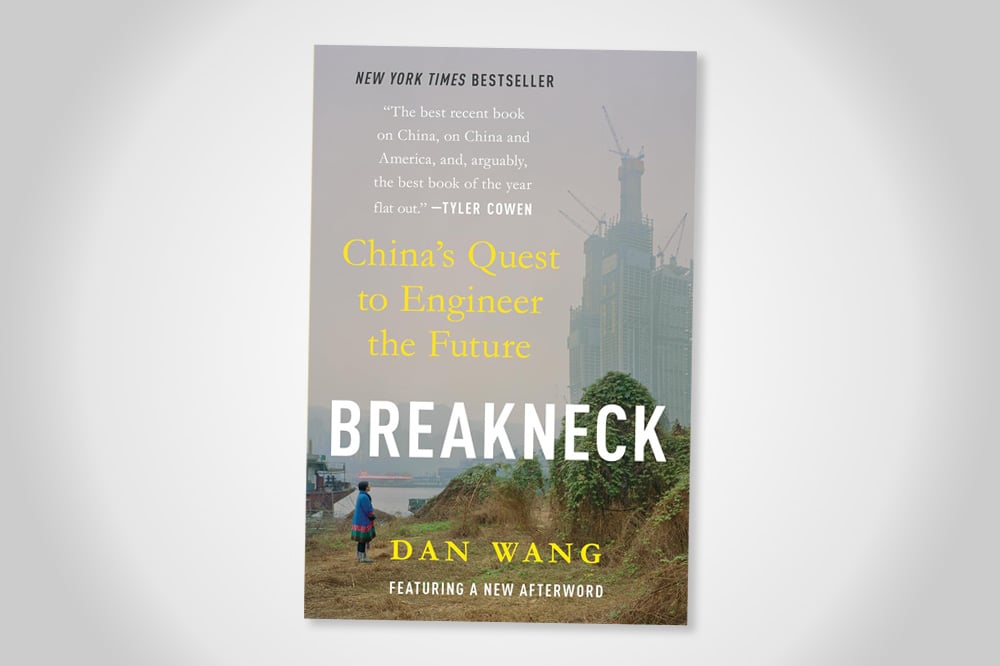
The core argument in Dan Wang’s superbly written and deeply reported book Breakneck is that China is run by engineers and an engineering mindset, whereas lawyers and legal thinking are dominant in the U. S. For Wang, who was born in China, grew up in Canada and the U. S., and has lived in China as an adult, this engineering-versus-legal framework is key to understanding both countries.
China’s political economy is built around national development and not the values of pluralism or the protection of individual rights. The ethos of prioritizing the good of the nation over the rights of the individual enables outstanding achievements such as China’s world-leading construction of high-speed rail (31,000 miles and counting). Other examples include the 118,500 miles of highways (compared to around 48,000 in the U. S.) and 560 miles of new metro lines in 2004 alone. Last year, China installed more new solar capacity than the rest of the world combined.
The price of all this national investment in infrastructure is that China has also brought an engineering mindset to social policy. The architect of the disastrous one-child policy, Song Jian, was not a demographer (thankfully) but an aerospace engineer. As Wang thoroughly documents in Breakneck , the average Chinese citizen pays a high price in terms of individual freedoms and access to a social safety net in exchange for the country’s ability to channel resources and override any opposition to large-scale infrastructure projects.
What makes Breakneck such a good book is the balance that Wang brings to his arguments. He wants the U. S. to be more like China in making long-term, large-scale investments (particularly in transportation, housing and clean energy) and for China to be more like the U. S. in its respect for individual rights and protections. Mostly, he wants those of us in the U. S. to be curious about how China has been able to leapfrog the U. S. in creating the conditions for world leadership in everything from electric vehicles to high-speed trains and clean energy.
Reading Breakneck , I kept thinking about how many of our college and university campuses have felt like giant construction zones over the past couple of decades. The U. S. can’t seem to build high-speed rail, but we have been good at building big on our college campuses. At the bottom of this review, I’ve included a list of the biggest campus building projects (nonmedical and nonstadium) that I’ve been able to find. ( Let me know what I’m missing.)
One of the attributes I love about higher education is that, at our best, we combine a long-term, mission-driven strategic orientation with governance and funding structures that enable us to undertake big projects. The narrative about higher education is often negative. We seem to be constantly in crisis, with existential threats ranging from the demographic cliff to our susceptibility to cost disease to public disinvestment to the erosion of public faith in the value of a college degree.
Reading Breakneck is a reminder that the ability to make long-term investments in physical infrastructure, the place where China excels most, does not require a political structure as autocratic as China’s. Universities are not democracies, but we are pretty good (when compared to other types of organizations) at respecting individual autonomy and of promoting pluralistic beliefs. If you don’t think that is true, spend a minute working at a for-profit company and you will quickly come to realize that the typical person who works in higher ed has considerably more agency than the typical corporate employee.
Let’s get more curious on our campuses about both China and infrastructure.
What are you reading?
- Washington University in St. Louis: Jeffrey T. Fort Neuroscience Research Building . Budget: $616 million. Start: March 2020. Completion: dedicated Jan. 18, 2024.
- UC San Diego: Ridge Walk North Living and Learning Neighborhood (2,400-bed residence and academic space). Budget: $537 million. Start: Summer 2022. Completion: Fall 2025.
- UC San Diego: Triton Center (four-building gateway complex: alumni/welcome, health and wellness, administration, gallery and event hall). Budget: $428 million. Start: ground broken 2023. Completion: initial openings fall 2026.
- University of Wisconsin-Madison: Phillip A. Levy Engineering Center (395,000 square feet, mass-timber learning wing). Budget: $419.8 million. Start: groundbreaking April 17, 2025. Completion: Substantial completion expected December 2028.
- UC Berkeley: People’s Park Student Housing (approximately 1,100 beds plus supportive housing). Budget: may exceed $400 million over all ($312 million construction plus $53 million contingency, plus approximately $90 million supportive housing). Start: Construction restarted in 2024. Completion: Expected fall 2027.
- Princeton University: Princeton University Art Museum (Adjaye Associates with Cooper Robertson; 146,000 square feet). Budget: approximately $300 million (estimated; Princeton has not published an official figure). Start: Construction began late 2021. Completion: Public opening Oct. 31, 2025.
- Virginia Tech: Innovation Campus Academic Building One (Alexandria, Va.; 300,000-square-foot graduate facility). Budget: $302 million (building) within a $1.1 billion Innovation Campus program. Start: Construction began September 2021. Completion: Opened January 2025; ribbon cutting Feb. 28, 2025.
- UC Berkeley: Helen Diller Anchor House (14-story, 772-bed transfer student residence). Budget: $300 million (entirely donor-funded). Start: Construction began 2022. Completion: Opened Aug. 21, 2024.
- Texas A&M University: Texas A&M Space Institute (400,000 square feet at NASA Exploration Park, Houston). Budget: $200 million (state-funded). Start: Groundbreaking Nov. 15, 2024. Completion: Targeted fall 2026.
- Purdue University: Mitch Daniels School of Business Building (164,000 square feet, six stories). Budget: $168 million (gift-funded; $125 million building plus $43 million classrooms, demolition, renovations). Start: Groundbreaking April 2025. Completion: Targeted August 2027.
Read Full Intelligence Briefing
Access the complete report and original data sources from Inside Higher Ed.
View Source Material

